The terms hydrant tank and fire water tank are often used interchangeably in fire protection discussions. While they are closely related, they do not always describe the same type of water storage solution.
Understanding the distinction is important when planning a fire protection system, evaluating storage requirements, or selecting equipment for a commercial or industrial facility.
This article explains how hydrant tanks differ from broader fire water storage systems and where each solution is typically used.
Understanding Hydrant Tanks
Hydrant tanks are designed specifically to supply water to fire hydrant systems. They store dedicated firefighting water that can be accessed through hydrant infrastructure during an emergency.
These tanks are commonly installed at industrial facilities, warehouses, commercial developments, and large residential sites. Their primary role is to provide a dependable water source when firefighting demand exceeds the capacity of the local water supply.
To learn more about their function within a fire protection network, explore hydrant tanks.
Typical hydrant tank systems include:
- Water storage tanks
- Fire pumps
- Pipework
- Hydrant outlets
- Control equipment
The system is designed to deliver the flow rates required for effective firefighting operations.
What are Fire Water Tanks?
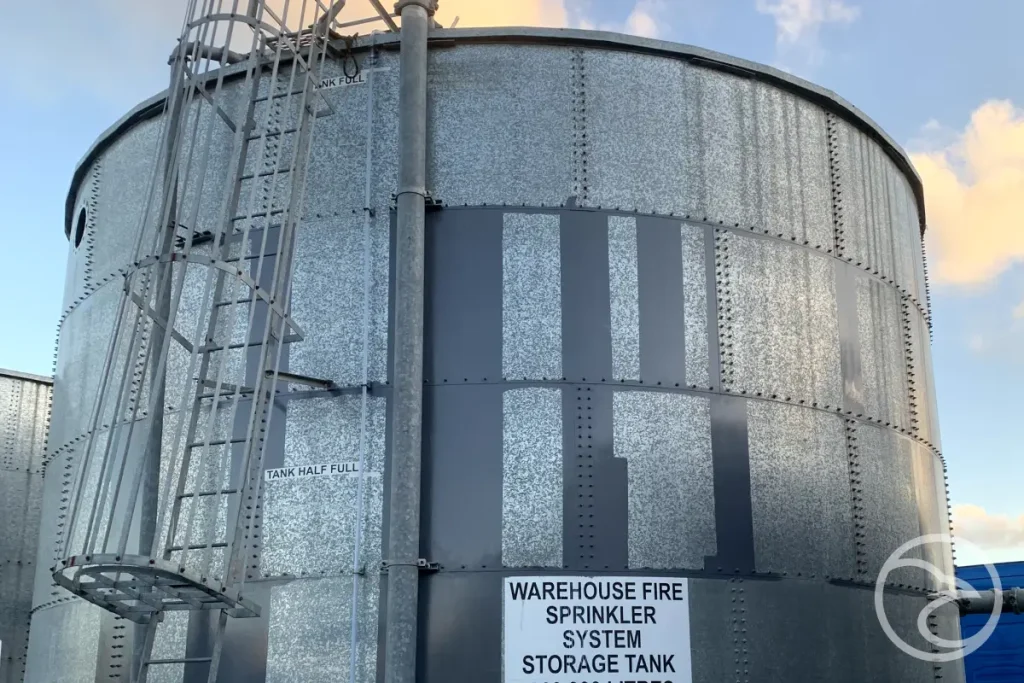
Fire water tanks are a broader category of water storage systems used for fire protection purposes.
Unlike hydrant tanks, which are generally linked to hydrant networks, fire water tanks may support several different suppression systems.
These can include:
- Fire hydrants
- Sprinkler systems
- Deluge systems
- Water monitors
- Combined fire protection systems
Because of this broader application, many hydrant tanks can be considered fire water tanks. However, not every fire water tank functions solely as a hydrant tank.
For facilities requiring multiple fire protection systems, a fire water tank often serves as a central water reserve.
More information about these systems can be found on the fire water tanks page.
Key Differences Between Hydrant Tanks and Fire Water Tanks
Although the two terms are closely related, several important differences should be considered.
Purpose
Hydrant tanks are dedicated to supporting hydrant systems.
Fire water tanks may supply one or several fire protection systems.
System Coverage
A hydrant tank usually serves a specific firefighting network.
A fire water tank may support hydrants, sprinklers, and other suppression equipment simultaneously.
Storage Capacity
Storage requirements vary according to system demand.
Fire water tanks serving multiple systems often require larger storage volumes.
Design Requirements
Hydrant tanks are typically designed around hydrant flow requirements.
Fire water tanks may need to accommodate a wider range of operational conditions.
Future Expansion
A broader fire water storage solution can provide greater flexibility for facilities planning future upgrades.
When is a Hydrant Tank the Best Choice?
A dedicated hydrant tank is often the preferred option when hydrants are the primary fire protection measure.
This approach is common in:
- Warehouses
- Manufacturing plants
- Distribution centres
- Industrial facilities
- Commercial developments
Dedicated systems can simplify design and ensure a reliable water supply during firefighting operations.
For a detailed explanation of tank operation and system integration, read how hydrant tanks work.
Common Misconceptions about Hydrant Tanks and Fire Water Tanks
Because the terminology is similar, misunderstandings are common.
One of the most frequent misconceptions is that hydrant tanks and fire water tanks are completely different products. In reality, a hydrant tank can often be considered a type of fire water tank.
Another misunderstanding is that larger tanks automatically provide better fire protection.
Tank capacity is only one factor. System design, water demand, pump performance, and distribution infrastructure all influence overall effectiveness.
Some people also assume that every fire water tank supports multiple suppression systems. While many do, some are designed to serve a single fire protection application.
Understanding these distinctions helps ensure the right solution is selected for each facility.
When is a Fire Water Tank More Suitable?
Facilities with multiple fire protection systems may benefit from a broader fire water storage solution.
This is particularly common in large industrial environments where hydrants, sprinklers, and specialised suppression systems operate together.
A fire water tank may be the better choice when:
- Multiple suppression systems require water
- Large storage volumes are needed
- Future expansion is planned
- Integrated fire protection strategies are used
The final design should always reflect the site’s risk profile and operational requirements.
Important Factors to Consider
Choosing between a hydrant tank and a broader fire water storage solution depends on several factors.
Key considerations include:
- Fire protection objectives
- Site size and layout
- Water demand calculations
- Future growth plans
- Local regulatory requirements
Compliance should also be considered during the design process. Additional guidance is available in fire safety standards explained: the role of AS1851.
Conclusion
Hydrant tanks and fire water tanks both provide critical water storage for fire protection systems. However, the terms are not always interchangeable.
A hydrant tank is generally dedicated to supplying a fire hydrant network. A fire water tank is a broader storage solution that may support multiple suppression systems.
Understanding these differences helps ensure the selected system aligns with operational needs, fire protection objectives, and long-term site requirements.