
Choosing a water storage tank involves more than selecting a required capacity. The physical dimensions also affect installation, access, maintenance, and site planning.
Water storage tank dimensions can vary significantly between tank designs. Two tanks with similar capacities may have very different footprints and heights.
This is especially important for commercial and industrial installations. Available space may limit the width, length, height, or configuration of a tank.
Modular panel tanks provide greater flexibility in these situations. Their dimensions can often be configured around capacity requirements and available installation space.
This guide explains water tank sizes and dimensions, capacity, footprint, and the main factors affecting tank sizing.
Understanding Water Storage Tank Dimensions
Water tank dimensions describe the physical measurements of a tank. These measurements usually include length, width, height, or diameter.
The required measurements depend on the tank design. Rectangular tanks usually use length, width, and height. Cylindrical tanks commonly use diameter and height.
Capacity is closely connected to these dimensions, but the two terms are not interchangeable. Capacity describes how much water a tank can hold. Dimensions describe how much physical space the tank occupies.
For example, two tanks could provide similar storage capacity while using different configurations. One may be taller with a smaller footprint. Another may be wider and lower.
Important measurements generally include:
- tank length;
- tank width;
- tank height;
- diameter for cylindrical tanks;
- total footprint;
- nominal capacity;
- usable water capacity;
- clearance around the tank.
External dimensions are particularly important during installation planning. They determine whether the tank can fit within the available site. However, the tank itself is not the only space requirement. Installers may also need clearance for access, connections, valves, ladders, and future maintenance.
Water Tank Sizes and Capacity Explained
Water tank sizes are often described by capacity. Common measurements include litres, gallons, cubic metres, or other regional units. However, capacity alone does not provide enough information for selecting a tank.
A project requiring 20,000 litres of storage does not automatically require one standard set of dimensions. Different tank types can achieve that capacity using different shapes and configurations.
The relationship between water tank sizes and capacity becomes particularly important on restricted sites. A tall tank may work where ground space is limited. A wider and lower configuration may suit a location with strict height restrictions.
This is one reason tank sizing should begin with both capacity and site conditions.
The design should consider the required water volume alongside:
- available floor area;
- maximum allowable height;
- structural conditions;
- access restrictions;
- inlet and outlet positions;
- maintenance requirements;
- the intended water storage application.
For larger commercial systems, choosing dimensions without considering these factors can create installation problems later.
What Determines Water Storage Tank Dimensions?
There is no universal set of water storage tank dimensions suitable for every project. Several factors influence the final configuration.
Required Storage Capacity
Required capacity is usually the starting point. The system must provide enough stored water for its intended application. This requirement can vary considerably between commercial buildings, industrial facilities, and fire protection systems.
Once capacity is established, designers can consider which physical configuration can provide that volume.
Available Footprint
The available footprint can significantly influence tank dimensions. Some sites have plenty of horizontal space but limited height. Others have a small footprint with greater vertical clearance.
Plant rooms, basements, rooftops, and existing facilities can present particularly restrictive conditions. A tank configuration should use the available space efficiently without compromising access or operation.
Height Restrictions
Height is another important consideration. Building structures, ceilings, rooflines, services, and local site conditions can restrict the maximum tank height.
Increasing tank height can reduce the required footprint in some configurations. However, structural and operational requirements must also be considered.
Tank Construction
Different tank designs create different dimensional possibilities. A one-piece tank has fixed dimensions determined during manufacture. Large units can also present transportation and site access challenges.
Modular panel water tanks offer greater configuration flexibility. Individual panels are assembled on site to create the required tank structure.
This approach can be valuable where storage capacity must fit within specific dimensional restrictions.
Installation and Access
A tank may technically fit within a space while still being unsuitable for installation. Components need to reach the installation location. Workers also need sufficient space to assemble or position the tank safely.
Access routes may include narrow doors, corridors, stairs, service areas, or restricted plant rooms. These factors should be considered before final tank dimensions are confirmed.
How Panel Water Tank Dimensions can be Configured
Panel water tanks are particularly useful where standard tank dimensions do not suit the available space. Their modular construction allows individual panels to form a larger structure. This provides more flexibility than many fixed one-piece designs.
A required capacity can potentially be achieved through different dimensional configurations. For example, a site with limited floor space may benefit from a taller configuration. Another site may require a lower tank with a larger footprint.
The best configuration depends on engineering requirements and site limitations.
Panel tanks can therefore provide useful flexibility for:
- commercial buildings;
- industrial facilities;
- plant rooms;
- restricted-access locations;
- fire water storage;
- potable water storage;
- large-volume storage applications.
Modular construction also simplifies access to some difficult installation locations. Components can be transported separately and assembled at the final location. This can be particularly valuable where installing a large pre-assembled tank would be impractical.
Water Storage Tank Dimensions vs Tank Capacity
Tank capacity and tank dimensions are directly related, but they should not be treated as identical specifications. For a simple rectangular space, geometric volume can be calculated using:
Volume = Length × Width × Height
For example, increasing any of these three dimensions increases the theoretical volume. However, real tank sizing is more complex than applying this formula.
The stated external dimensions do not necessarily represent usable water volume. Structural components and operating requirements can affect actual capacity. The tank may also require freeboard or other design allowances.
Therefore, calculating a rectangular volume provides useful context. It should not replace the manufacturer’s specifications or project-specific engineering. The distinction becomes particularly important when comparing different water tank sizes.
Two products described using the same nominal capacity may not have identical external dimensions or usable capacities.
Water Tank Footprint vs Height
One of the most important decisions when sizing water tanks involves balancing footprint against height. The footprint is the amount of ground or floor area occupied by the tank.
A larger footprint requires more horizontal space. This may be difficult in crowded industrial or commercial locations. Increasing height can sometimes provide additional capacity without expanding the footprint.
However, taller tanks introduce their own considerations. Structural loads, access, roof clearance, and installation conditions must be evaluated.
A low and wide configuration may be more appropriate when vertical clearance is restricted. There is no universally preferable option.
The best balance depends on:
- available installation area;
- permitted height;
- required capacity;
- structural conditions;
- tank construction;
- access requirements;
- maintenance needs.
Modular panel tanks can be useful because dimensions can be configured around these restrictions.
How to Size a Water Storage Tank
Sizing a water storage tank should follow a structured process. Starting with a preferred physical size can result in insufficient capacity or installation problems.
1. Determine the Required Capacity
First, establish how much water needs to be stored. This depends on the application and system requirements. A commercial water system may have very different requirements from a fire water storage system.
Capacity calculations should be completed according to the relevant project requirements and applicable standards.
2. Measure the Available Installation Space
Next, establish the actual space available. Record the maximum usable length, width, and height. Do not assume that the entire room or site can be occupied by the tank.
Nearby equipment, walls, pipes, structural elements, and access routes may reduce usable space.
3. Consider Installation Access
Check how tank components will reach the installation area. A tank that fits after installation may still be impossible to transport through the available access route.
Modular construction can provide an advantage in difficult locations because individual components can be moved separately.
4. Allow for Connections
Tank sizing should account for more than the main storage structure.
Space may be required for:
- inlet connections;
- outlets;
- overflows;
- drains;
- valves;
- level controls;
- access points;
- external pipework.
Ignoring these components can create a tank layout that works on paper but not in practice.
5. Allow for Inspection and Maintenance
Future access matters just as much as initial installation. A tank should not be positioned so tightly that essential components become difficult to inspect.
Adequate access can make tank inspection services and routine maintenance easier throughout the tank’s service life.
Planning for this requirement during sizing is generally easier than modifying the installation later.
6. Select the Tank Configuration
Once capacity, available space, access, and operational requirements are known, an appropriate configuration can be selected. For modular tanks, several combinations of length, width, and height may potentially meet the required capacity.
The final configuration should balance storage performance with practical site requirements.
For complex commercial and industrial projects, tank engineering Sydney provides engineering support for tank sizing, structural requirements, and site-specific configurations.
Do Tank Shapes Affect Water Tank Dimensions?
Yes. Tank shape has a major influence on external dimensions and footprint. Cylindrical tanks use diameter and height as their main measurements. Their circular shape can be efficient for many storage applications.
Rectangular tanks use length, width, and height. They can make efficient use of square or rectangular spaces. Panel tanks are commonly designed in modular configurations. This makes them particularly useful where a tank must fit within defined boundaries.
Flexible tanks use a completely different design approach. Their dimensions can change as they fill and empty. The right tank type therefore depends on more than capacity.
A project should consider how the tank shape interacts with the available site, installation requirements, and intended application.
What are the Dimensions of a 20,000 Litre Water Tank?
There is no single universal answer. A 20,000 litre water tank can have different dimensions depending on its shape, construction, manufacturer, and configuration.
A cylindrical 20,000 litre tank will have different measurements from a rectangular panel tank with a similar capacity. Even two panel tanks can potentially provide comparable capacity through different length, width, and height combinations.
This flexibility matters when the installation site has dimensional restrictions. Instead of searching for one standard 20,000 litre water tank size, consider both required capacity and available installation space.
The appropriate dimensions should then be determined from the tank system’s actual specifications.
Common Water Storage Tank Sizing Mistakes
Tank sizing problems often occur because capacity receives all the attention. Physical installation requirements are considered too late. One common mistake is selecting a tank based only on litres or gallons.
Another is measuring the available space without allowing enough clearance around the tank.
Other common issues include:
- overlooking maximum height;
- ignoring access routes;
- forgetting pipework clearance;
- failing to consider foundation requirements;
- restricting inspection access;
- leaving insufficient maintenance space;
- overlooking future system requirements;
- assuming all tanks of the same capacity have identical dimensions.
These problems can become expensive after installation begins. Good planning considers the complete tank system rather than the storage vessel alone.
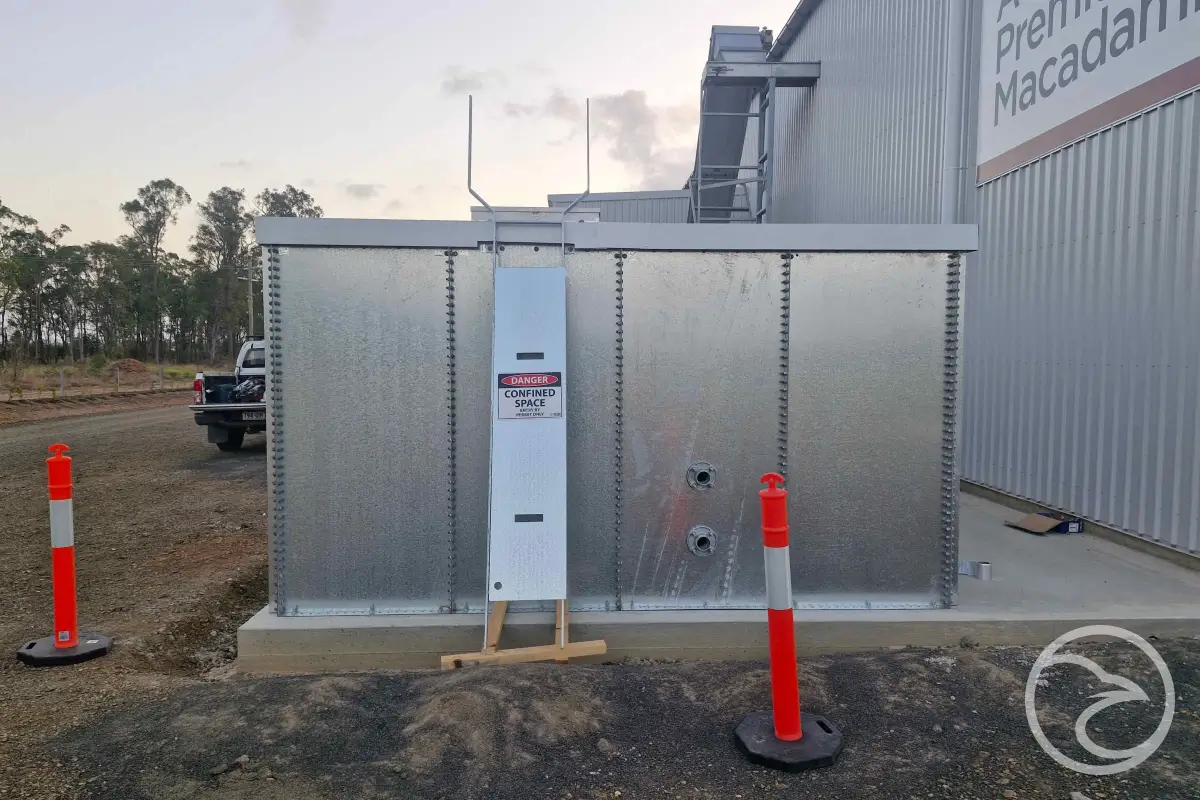
Water Tank Dimensions for Different Applications
The intended application can significantly influence water tank sizing.
Commercial Water Storage
Commercial buildings may have limited plant room space. Tank dimensions often need to fit around existing services and structural features.
A configurable design can help maximise available space.
Industrial Water Storage
Industrial sites may require larger capacities and more complex connections. The tank layout must account for operational requirements, surrounding equipment, and safe access.
Fire Water Storage
Fire protection systems can require substantial dedicated water storage. The required capacity should be established from the applicable system design and regulatory requirements.
Physical dimensions can then be developed around the available site. For fire water tanks, dimensions should be planned around required capacity, available space, system design, and applicable fire protection requirements.
Potable Water Storage
Potable water systems require appropriate materials and hygienic design. Tank sizing should also consider access for inspection, cleaning, and ongoing maintenance.
Regardless of application, capacity should not be considered separately from dimensions and site conditions.
Why Maintenance Access Should Influence Tank Dimensions
Maintenance requirements are easy to overlook during initial tank sizing. However, water storage tanks are long-term infrastructure assets. They require ongoing inspection and maintenance throughout their service life.
The surrounding layout should provide appropriate access to relevant components. Poor access can make routine work more difficult. It can also increase the complexity of inspections and repairs.
The tank’s roof, panels, connections, internal components, and access points may all require attention over time. A good design therefore considers the entire lifecycle of the tank.
Planning suitable access from the beginning supports safer and more efficient water tank maintenance later.
This is another reason the smallest possible footprint is not always the best solution.
Are there Standard Water Storage Tank Dimensions?
Water storage tanks may be available in standard configurations. However, there is no single standard dimension that applies to every tank or application. Dimensions vary according to capacity, material, tank type, manufacturer, and design requirements.
Modular systems provide additional flexibility because different configurations can be created from standardised components. This makes it possible to adapt the overall tank dimensions to a particular site.
The required capacity remains important, but it should be considered alongside available space and operational requirements.
How to Choose the Right Water Tank Size
Choosing the right water tank size requires balancing several requirements rather than focusing on one number. Start with the required storage capacity. Then assess the available footprint and maximum height.
Consider how the tank will reach the installation location and how it will be assembled. Next, identify the required pipework, valves, access points, and surrounding equipment.
Finally, consider future inspection and maintenance. For panel water tanks, the ability to modify the dimensional configuration can provide significant flexibility.
A well-planned tank should provide the required capacity while fitting the site without compromising operation or future access.
Final Considerations
Water storage tank dimensions should never be selected from capacity alone. Length, width, height, footprint, access, connections, and maintenance requirements all influence the suitability of a tank.
The same storage capacity can also be achieved using different physical configurations. This is where modular panel water tanks can offer an important advantage. Their configuration can be adapted to suit many commercial and industrial installation constraints.
Careful sizing helps ensure the tank provides the required storage while fitting the available site. It also supports practical installation, reliable operation, and easier maintenance throughout the tank’s service life.